Ben Nixon, Vice President of the Enterprise Technology with the EstesGroup.
I am here today to speak to you a few moments on IT performance testing and tuning.
You know, everyone wants your IP system to operate efficiently. I’ve got 17 years of Epicor experience, and this service can help you identify and eliminate as many hardware and configuration bottlenecks as possible.
Are these negatively affecting your assisted performance?
Have you ever thought about the cost of downtime?
These are items we could help you with. You know, a little time spent now can make your operation much more efficient.
Have you ever looked at the cost of downtime? How much does a down man-hour cost? Many people do not look at these items. Take a look at that. It doesn’t take long to realize we can make things much more efficient. We can come in, and we can help you test your servers, tune them, set up maintenance plans, identify bottlenecks, review your resources to see if they’re configured properly. We run the Epicor performance diagnostics tools to see if your application is performance and Epicor’s quality assurance performance benchmarks.
How much does a down man-hour cost? Many people do not look at these items. Take a look at that. It doesn’t take long to realize we can make things much more efficient. We can come in, and we can help you test your servers, tune them, set up maintenance plans, identify bottlenecks, review your resources to see if they’re configured properly. We run the Epicor performance diagnostics tools to see if your application is performance and Epicor’s quality assurance performance benchmarks.
Many people do not look at these items. Let’s take a look at these issues in your business. It doesn’t take long to realize we can make things much more efficient. We can come in, and we can help you test your servers, tune them, set up maintenance plans, identify bottlenecks, review your resources to see if they’re configured properly. We run the Epicor performance diagnostics tools to see if your application is performance and Epicor’s quality assurance performance benchmarks.
Is your SQL maintenance plan very much forgotten?
Everyone thinks SQL’s plug and play, do you? It is not.
SQL’s a great database. It needs some maintenance. We can help you do that. We can and will review your virtual configuration. It often — one little setting can make a difference. Upon completion, we give you a detailed report of what you’re gonna need. Uh, more satisfied users. User complaints come to a slowdown. These are all items that will help you, um, enabling your employees to do their jobs faster, providing better customer service, quicker diagnostics.
And the nice part is, I love to work with your people, your-your IT people. We’ll train them. We’ll show them what to look for, how to help keep this going. Give me a call for a free 30-minute consultation. Let’s see what Estes can do for you. Make your business run better with our Epicor training.
Tell us how we can help, what has been slowing your business down? We know technology should not, and we will ensure it will not again.
Ben Nixon, Vice President of the Enterprise Technology with the EstesGroup.
Here is what you need to know before you upgrade your Epicor ERP database.
I’m going talk to you a few moments about upgrading your Epicor database. You know, everyone wants to upgrade. You’ve got many people coming to you, telling you they can help you upgrade. Give Estes a call. We can help you. You have many considerations. This is not as simple as, “Push a button, and you’re upgraded.” This is not as simple as, “Put it in. No testing, no training, and walk away.” Let Estes help make your move efficient and safe.
Give EstesGroup a call at1-888-300-2340 to help you implement a safe database Epicor ERP Upgrade.
We can help you. There are many things to consider before you upgrade. This is not as simple as, “Push a button, and you’re upgraded.” This is not as simple as, “Put it in. No testing, no training, and walk away.” Let EstesGroup help make your move efficient and safe.
Upgrades fail for a variety of reasons; Lack of planning, Lack of testing. Failure to recognize changes required, No verification of data. Too often I see a customer upgrade and then before frustrated for a variety of the previous reasons. What is the impact on your business if the Epicor system is not functional or performing as it should?
You are moving forward with technology, let Estes help you embrace it and before more efficient.
Don’t take your business down. We can help you consider: Now is the time to possibly reimplement. Is now the time to virtualize? Is your hardware out of date? You know, Microsoft Server 2000 went out of date in July of 2015. If you’re still running on that, you’re walking in a danger zone. Let us help you decide if an upgrade is right and how to do it.
We have many choices for you.
We can help you, guide you as far as any services you need for ERP software training and consulting. Give usa call for a free 30-minute consultation. Thank you.
Respected global technology leader will expand EstesGroup offerings to include full IT enablement & integration of critical systems.
LOVELAND, CO – April 5, 2017 – EstesGroup, a leading Epicor ERP partner and managed services provider, today announced the appointment of Ben Nixon to the new post of Vice President of Enterprise Technology.
Nixon brings 17 years of Epicor ERP consulting experience and a strong background in complex business and technology environments. He’s recognized internationally as a value-added advisor to Epicor clients and his peers.
EstesGroup utilizes a proprietary 5-step PEAK methodology to provide best-in-class EPR services to more than 500 clients worldwide. EstesGroup has expertise in the manufacturing, distribution, medical and services industries and provides implementation, support, optimization, training and integration solutions for Epicor, NetSuite, IQMS, and Microsoft ERP.
“EstesGroup has been my go-to implementation partner for many years and the organization I would rely on to resurrect failing ERP implementations,” said Nixon. “Their staff is 100% certified, to the highest levels of ERP systems, often to a higher level of certification than even the publishers themselves. It’s tremendously exciting to now join the company and help expand their offerings to include database management, performance management, virtualization and disaster recovery planning.”
Before joining EstesGroup, Nixon served in a variety of technical leadership roles spanning 17 years at Epicor Software Corporation, a leader in industry-specific business software. Nixon’s experience includes ERP technical consulting and management consulting. He is recognized nationally and internationally as a leader in systems and database management.
“Ben is a respected global business and technology leader with strong cloud, SaaS and on-premise expertise,” said Bruce Grant, CEO, EstesGroup. “Ben’s solutions-focused approach and creative problem-solving skills have established him as a go-to expert in the ERP industry. Ben and his team will provide solutions to allow customers to remain on the leading technology edge and be competitive in the global marketplace. As a virtual CIO to EstesGroup’s clients, Ben will drive value-added IT infrastructure solutions from the planning stage, through implementation, and ongoing support.”
About EstesGroup
EstesGroup helps businesses run better. We provide solutions to industry-specific verticals including the needs of manufacturing, distribution, medical, retail, and service industry customers. With our own PEAK methodology and over 12 years of experience, our clients enjoy the highest level of professional support in the industry―in the cloud, hosted, or on premises – for their ERP or Managed Services needs.
“Focus on what you do best, and let us handle the rest!”
###
Media Contact: Jeff Klaubert EstesGroup Inc. Phone: 603-860-6078 Email: [email protected]
Ask us anything you want to accomplish, and we will help you acheive your goals.
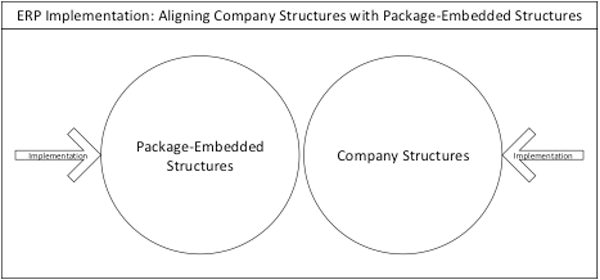
Contemporary systems theories frequently explain application implementations using the paradigm of structures. A structure can be thought of as a pattern of behavior implicitly used to govern a business process, be it system-driven or manual in nature. From the structuralist perspective, an organization consists of multiple overlapping structures, which guide the way it does business. An ERP system similarly consists of structures, which guide its functionality. ERP implementation strategy thus constitutes a situation in which the structures inherent in an organization’s business process need to be brought into harmony with the structures provided by the implemented package. The familiar Venn diagram is helpful in representing the challenge of integrating or “overlapping” enterprise package-embedded structures and company structures:
Adapted from Soh and Sia, 2005
Ideally when implementing the system, a perfect overlap can be identified between the ERP structure and the company structure—that is, the capabilities of the system perfectly address the business requirements of the implementing company. Using the Venn diagram, this would be depicted by the two structure-circles perfectly overlapping. In reality, this rarely occurs—even when the best possible system is selected for a given implementation, misalignments between company structures and package-embedded structures inevitably occur. Veteran project managers do not panic when misalignments are identified, as they understand this inevitability. The goal of an ERP implementation strategy is to maximize the overlap between the company and the package, understanding that misalignments will occur.
Adapted from Soh and Sia, 2005
Given the inevitability of misalignments between ERP structure and company structure, it comes as no surprise that successful implementation projects surface misalignments early, and identify them clearly. Once identified, work can begin to resolve the misalignments and “close the gaps.” According to some theorists, organizations have one of two options when closing the gaps created by structural misfits: organizational adaptation or package modification.
Adapted from Soh and Sia, 2005.
As part of an Epicor ERP implementation strategy, organizational adaptation may involve additional prototyping with the system’s standard configuration and master file settings, in order to identify alternative means of addressing the businesses requirements. It may also involve the creation of manual processes or “workarounds” to address business needs. Within an Epicor context, package modification may involve the creation of custom queries, dashboards or reports to address information requirements, or the customization of a given form to allow the entry of custom data fields. It also may involve the use of BPM’s to provide specific validation or automation functionality. It may further involve a Service Connect workflow to interface with an external payroll or Engineering system. Quite often, addressing misalignments between ERP structure and company structure involves a combination of configuration, workarounds, and customization. The overall goal of these activities is to minimize the degree of customization required while supporting the company’s strategic core competencies.
As we’ve noted, misalignments between ERP structure and company structure are a normal and expected occurrence in the course of implementing an enterprise system. Not surprisingly, successful projects are often defined not by the presence of misalignments, but by the project team’s reaction to them. When companies plan for misalignments as part of a normal implementation, they can focus on closing the gaps, without sending the company into a panic when they surface. In doing to, they improve their chances of successful implementation, and optimally using the package they’ve implemented.
While many small, single-facility companies find Epicor’s ERP offerings to be an appropriate fit for their businesses, Epicor offers extensive capabilities to larger companies seeking to implement across multiple locations or divisions. Epicor’s multi-site module allows customers with multiple geographically-dispersed facilities to configure individual sites to manage the activities in each facility. For customers who consist of multiple independent business units, each with their own financials, Epicor offers the ability to define individual companies for each business unit.
While these capabilities are fine in themselves, it sometimes occurs that Epicor’s multi-site and multi-company capabilities are interpreted as mere matters of licensing and configuration—of purchasing the additional licensing and configuring the additional companies and sites to run the various entities within the business. This sounds simple enough, but focusing exclusively on licensing and configuration can be problematic for a number of reasons. Firstly, Epicor provides various opportunities for collaboration between business entities that allow companies the ability to design new processes that cross traditional business boundaries in new ways. To ignore these capabilities would be on par with buying a dune buggy only to park it in the driveway. Secondly, implementing across multiple companies and/or sites introduces many complicating factors to an implementation project, which may be unapparent at the project’s onset. These factors can exponentially complicate implementations, if left unmitigated and need to be incorporated in to the implementation plan.
Epicor’s multi-site module offers many more capabilities that allow large or geographically dispersed companies to streamline their processes across disparate locations. As companies seek to structure their organizations for future success, implementations become opportunities for reengineering. In such cases, implementation projects can become complicated, as business process decisions and project implementation decisions supersede system configuration. Some of the decisions that companies encounter might include the following:
Does the company intend to go live on Epicor with all companies/sites at the same time or is the preference to implement in a staggered sequence?
What level of process consistency does the company intend to have between sites or companies?
As part of the implementation, are there processes that the company intends to centralize across plants or companies?
Are there internal supplier-customer relationships that you wish to leverage between plants or companies?
Answering these questions is no simple matter—it takes a combination of business acumen, project management experience, and Epicor knowledge. EstesGroup offers implementation methodologies tailored to different approaches—be it a staggered implementation (one site-at-a-time), or a big bang (all sites concurrently). EstesGroup also offers business process management methodologies to cater to various centralized or decentralized management approaches.
EstesGroup also offers a pool of experienced consultants and project managers, well-versed in large corporate implementations across multiple sites and companies. Not only can we help you set up your system to run smoothly—we can help you develop a business process management strategy that leverages best practices and process excellence across multiple locations, while working these decisions into the implementation plan, so you can set up your company for the future on-time and on-budget.